The Batch Maps Out Crucial Skills for AI Engineers
DeepLearning.AI newsletter The Batch has detailed the practical skills developers need to build and deploy reliable artificial intelligence applications in production.
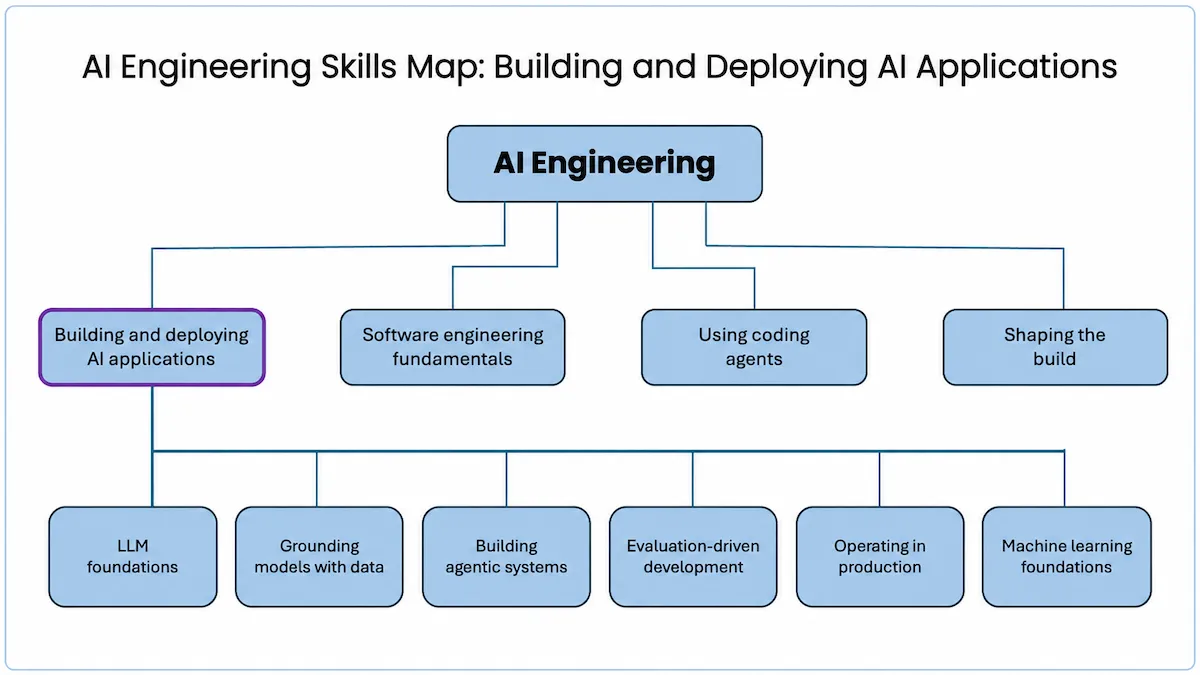
The Batch has expanded on its AI Engineering Skills Map, detailing the specific competencies required to build and deploy AI applications. This framework, developed by analyzing job postings, expert interviews, and survey responses, highlights how AI development differs from traditional software engineering. Because AI outputs are inherently unpredictable, developers must adopt highly iterative workflows, repeatedly testing and adjusting their systems based on intermediate results to build reliable applications from unpredictable components.
To succeed, practitioners must master large language model foundations, including tokenization, context window tradeoffs, cache hits, and reasoning effort levels. Grounding these models with data is equally critical, requiring engineers to choose between vector indexes, knowledge graphs, or semantic layers, and to build pipelines that convert PDFs, HTML, and images into clean inputs. Furthermore, developers must learn to design agentic systems. This involves structuring workflows that chain or parallelize LLM calls, managing memory architectures, and utilizing tools like MCP, command-line interfaces, and sandboxes, while implementing guardrails against risks like data exfiltration.
The publication emphasizes that evaluation-driven development is the most critical differentiator for top-tier AI engineers. This requires a disciplined error-analysis loop using deterministic code-based evaluations, LLM-as-a-judge frameworks, and human-in-the-loop testing. Once in production, engineers must monitor observability, detect drift, and mitigate adversarial prompt injections while optimizing for cost and latency through distillation and fine-tuning. Finally, a strong grasp of machine learning foundations, such as supervised learning, reinforcement learning, and the concepts of bias and variance, remains essential for making sound architectural decisions.
This is our own summary of reporting by The Batch