Periodic Labs Develops AI to Discover New Materials
Periodic Labs is building autonomous physical laboratories and training artificial intelligence models on real-world experiments to accelerate the discovery of advanced materials.
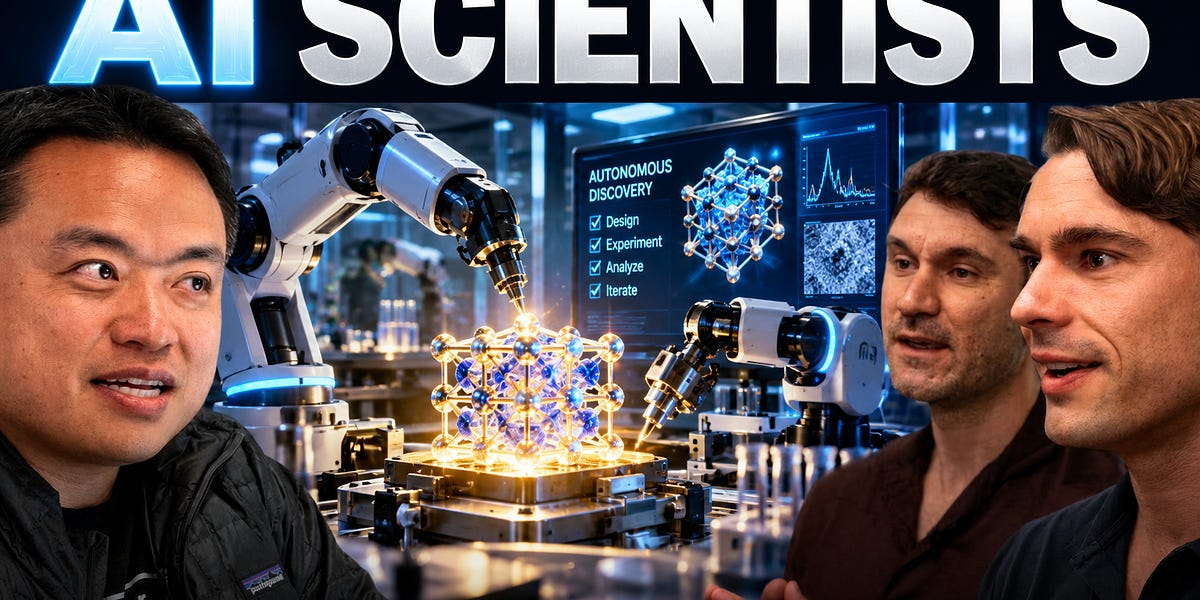
Periodic Labs, a scientific AI startup founded by Liam Fedus and Ekin Dogus Cubuk, is developing autonomous laboratories to pioneer what it calls synthesis superintelligence. Launched last September, the company aims to move beyond training AI on internet data by allowing models to conduct and learn from physical experiments. The founding team brings deep expertise from co-creating landmark systems such as ChatGPT, DeepMind's GNoME, OpenAI's Operator, MatterGen, and the neural attention mechanism.
The startup's approach combines reinforcement learning with high-throughput physical experiments, density functional theory simulations, and AI-powered materials characterization. To bypass the slow feedback loops of physical chemistry, Periodic Labs builds specialized AI agents for specific tasks, such as analyzing X-ray diffraction patterns to identify crystal phases. This setup allows the system to learn from noisy, real-world data and even failed experiments. The founders aim to give every piece of laboratory equipment what they describe as a 140 IQ to automate the entire scientific process, compressing decades of trial-and-error into months.
While tools like density functional theory are powerful, they fail to simulate complex phenomena like strong electron correlation. The physics of unconventional, high-temperature superconductivity, such as cuprates that superconduct above 77 Kelvin or 93 Kelvin, remain unsolved by theory alone. By grounding AI models in physical reality rather than pure computation, Periodic Labs seeks to discover novel materials like room-temperature superconductors, advanced batteries, and more efficient computing substrates.
For materials scientists and AI practitioners, this paradigm shifts the focus from digital optimization to physical sample efficiency. Instead of relying on models that might memorize textbook answers, researchers can train reinforcement learning agents on the actual process of doing science. This methodology ensures that AI reasoning generalizes to entirely novel physical systems, opening up what the founders call a larger surface area for luck in discovering materials that have never existed before.
This is our own summary of reporting by Latent Space