Sakana AI Namazu Beats Google Translate on Nuance
Sakana AI has updated its free translation service with Namazu, a new-generation model that outperforms Google Translate and DeepL at capturing complex Japanese cultural nuances.
Tokyo-based Sakana AI has upgraded its free translation platform, Sakana Translate, by integrating its new-generation Namazu model. Rather than building a massive system from scratch, the startup post-trained Moonshot AI's open Kimi K2.6 model specifically on Japanese language, culture, and business contexts. The updated service remains free for users with an account at translate.sakana.ai, offering bidirectional translation across Japanese, English, and Chinese.
In head-to-head evaluations using Sakana's own TransEvalnia framework, which ranks translations across 160 in-house Japanese-to-English tasks, the new Namazu model outperformed its rivals. It won against Google Translate 66.9% of the time, Claude Opus 4.8 at 56.8%, and DeepL at 54.0%. While these internal tests show Namazu leading on cultural nuances, public benchmarks paint a slightly different picture for general translation; the previous version of Sakana Translate scored 0.835 on the XCOMET-XL metric, trailing Google's Gemini 3.1 Pro at 0.851 and OpenAI's GPT-5.5 at 0.843.
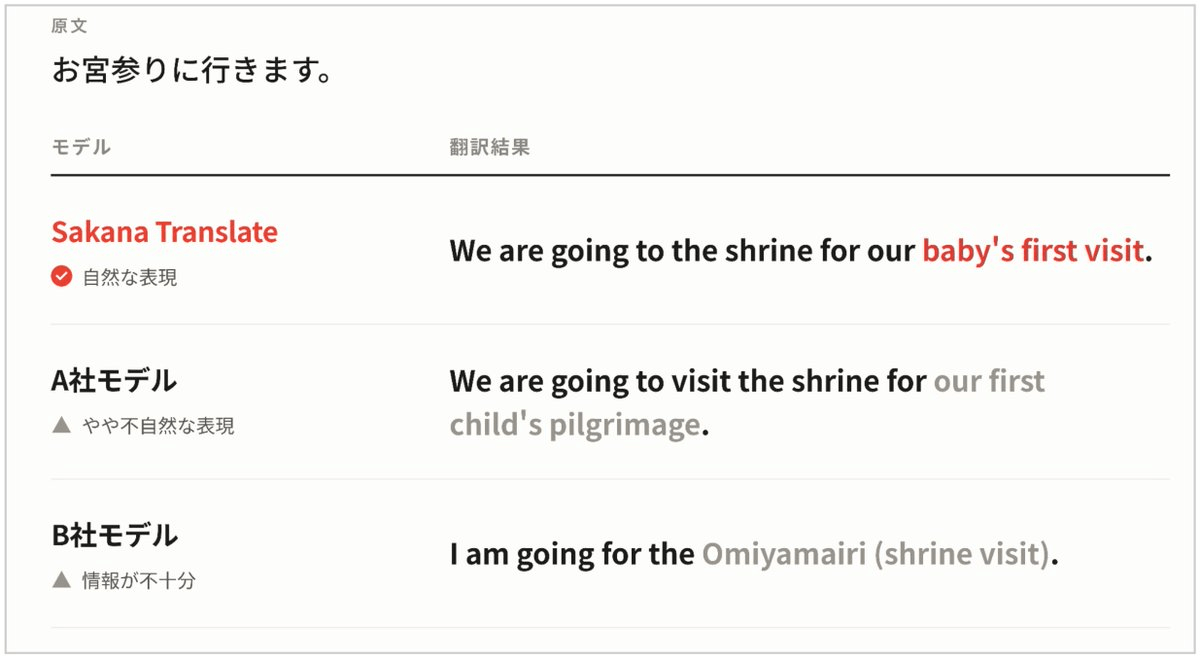
For practitioners handling marketing copy, customer communications, or business honorifics, this update addresses common machine translation failures. The model excels at translating culturally loaded terms like Omiyamairi—a newborn's first shrine visit—which general models often translate clunkily. Users can access three distinct modes: Translate, which streams up to 5,000 characters; Proofread, which highlights grammar and politeness changes via diffs; and Ask, which lets users query the AI about specific honorific choices.
Looking ahead, Sakana AI plans to transition this technology into enterprise environments. The company's roadmap includes file translation for PDF and Microsoft Office formats, glossary integration, API access, single sign-on, audit logs, and on-premises deployment options.
This is our own summary of reporting by AlphaSignal