Developers Turn to Ollama and Llama 3 for Local AI
As small language models mature, developers are increasingly deploying tools like Ollama to run compact models locally, securing data privacy and eliminating cloud API costs.
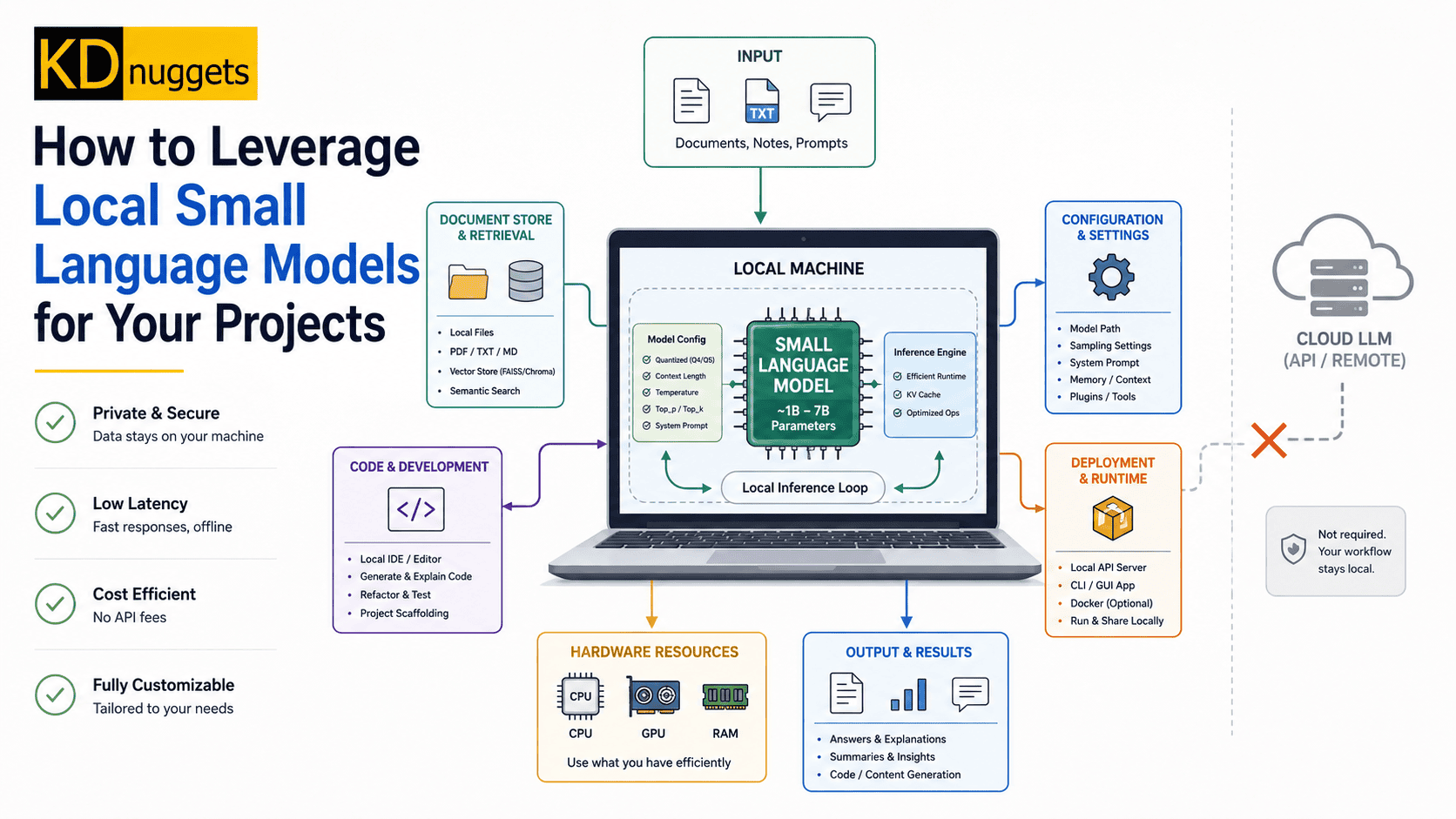
The landscape of artificial intelligence is shifting away from a total reliance on cloud APIs toward local deployment of small language models. These compact models, which typically range from 1 billion to 13 billion parameters, have matured to the point where they can run efficiently on consumer-grade hardware. By transitioning to local execution, developers can bypass the latency, unpredictable per-token billing, and data exposure risks associated with third-party cloud services.
To run these models effectively, practitioners must balance parameter size with hardware constraints. For instance, a popular 7 billion parameter model requires approximately 8 GB of VRAM or RAM to operate at reasonable speeds using 4-bit quantization. Developers can choose from several prominent model families, including Llama 3, Mistral, Gemma 2, Phi-3, and Qwen 2.5, or opt for task-specific variants like Code Llama and Qwen-Coder. Most of these models are distributed in the GGUF format, allowing them to be quantized to 4-bit or 5-bit precision to minimize memory usage without a severe drop in output quality.
The open-source tool Ollama has emerged as a primary driver of this local transition, offering a simple command-line interface to download and run models on macOS, Linux, and Windows. Ollama automatically handles GPU acceleration and hosts a local REST API on port 11434, allowing developers to integrate local models into existing workflows using frameworks like LangChain or LlamaIndex. Practitioners can further customize model behavior using Modelfiles to adjust system prompts, temperature settings, and context window lengths.
This local setup enables several practical architectures, such as offline document assistant pipelines using retrieval-augmented generation, local coding assistants, and multi-agent workflows. Before fully committing to a specific model, developers are encouraged to build a small evaluation set of 20 to 50 representative examples to test performance. This hands-on testing helps identify specific failure modes and ensures the model can handle actual context lengths before deployment.
This is our own summary of reporting by KDnuggets