Harvey Unveils Tenet Model for Long-Horizon Legal Work
Legal AI startup Harvey has introduced Harvey Tenet, a post-trained model designed to tackle complex, multi-step legal tasks without sacrificing foundational reasoning performance.
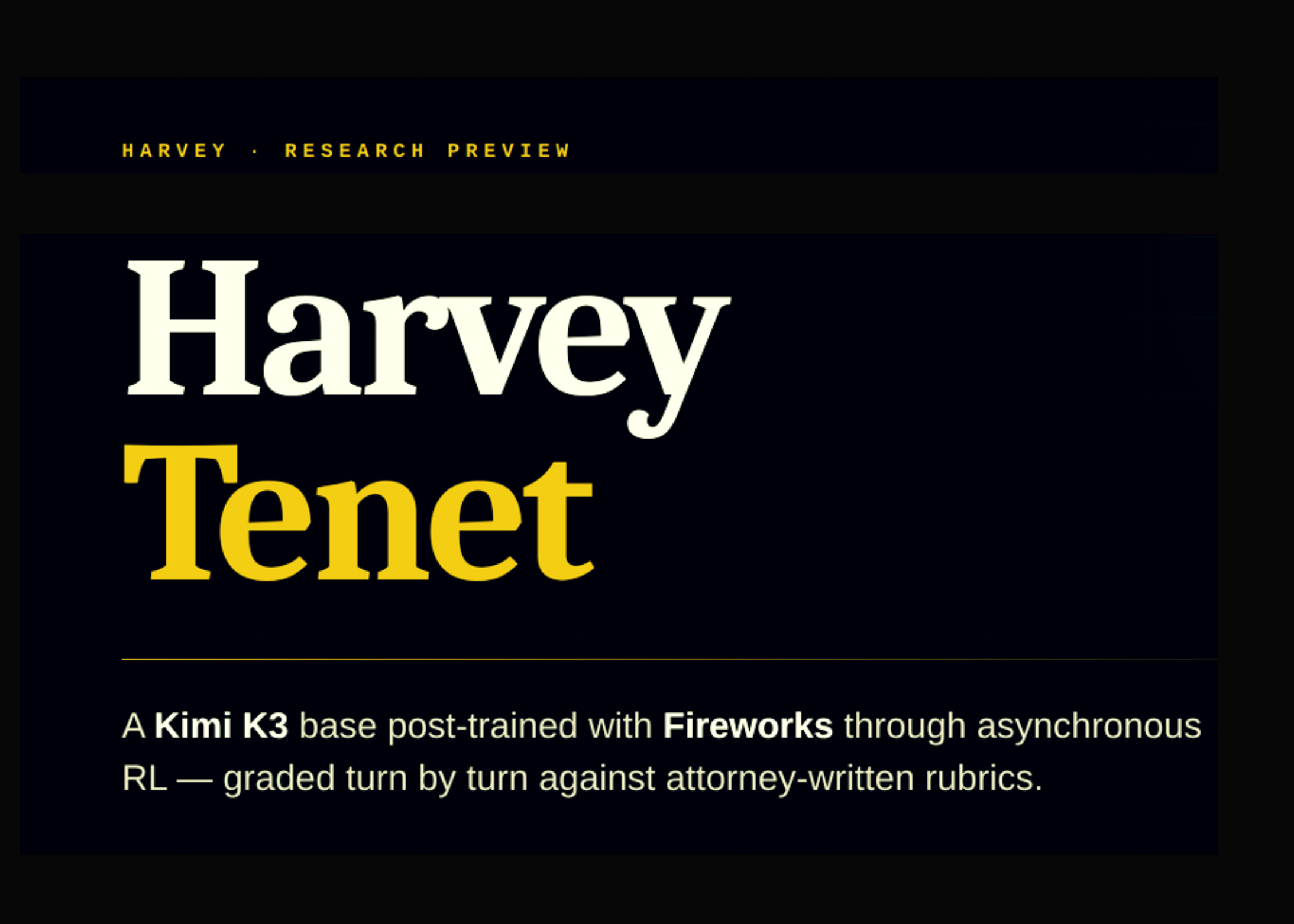
Harvey has announced a research preview of Harvey Tenet, its first post-trained model. Built on the open-weight Kimi K3 base, Tenet was developed with Fireworks using asynchronous reinforcement learning on long-horizon legal tasks. Training utilized approximately 150 NVIDIA B300 GPUs over two months, leveraging synthetic, public, and human expert legal data. The optimization employed GSPO with a rank-64 LoRA over the full K3 network, spanning roughly 1,750 environments and over 10,000 rollouts per epoch, with Kimi 2.6 as the grading judge.
On Harvey’s Legal Agent Benchmark (LAB), Tenet completed nearly twice as many held-out tasks as the base K3 model, boosting the all-pass rate by 9 percentage points. On LAB: Contracts, it completed 20% more tasks, raising the all-pass rate by 2 percentage points to claim a state-of-the-art rating. These capabilities transferred to untrained benchmarks, showing improvements on Mercor’s APEX Agents and Crosby’s Redline Bench, while maintaining baseline scores on LegalBench, CUAD, MAUD, and Scale's PRBench.
Alongside Tenet, Harvey developed specialized sub-agents. For M&A diligence, which can traverse up to 80 million tokens on LAB: Diligence, a baseline GLM-5.2 orchestrator reached 46.1% compared to the standard baseline of 43.8%. When post-trained in a Recursive Language Model harness, it reached 60.1%. For document review, a post-trained GLM-5.2 improved answer quality by 3.6 points and citation quality by 12.1 points at one-tenth the cost per cell. For firm knowledge, a Qwen3.8-27B model compressed 100 million tokens of client matters into 1 million tokens of structured knowledge, raising the pass rate by over 15%, reducing trajectory tokens by 58%, and cutting query costs by roughly 90% to achieve 190.8 intelligence-per-token versus 129.3 for the best frontier configuration.
For legal practitioners, Tenet represents a shift toward highly specialized, cost-effective agentic workflows. By utilizing reward shaping that prioritizes shorter trajectories, the model reduces token consumption to deliver quality gains at a stable cost. Although Harvey has not yet released Tenet's weights, a model card, or an API, the technology is slated to transition into Harvey's enterprise platform, offering law firms and in-house teams a blueprint for owning specialized, high-performance legal models.
This is our own summary of reporting by MarkTechPost