Galbot Robots Complete 100 Autonomous Tennis Rallies
Beijing-based Galbot's humanoid robots completed over 100 consecutive autonomous tennis rallies, demonstrating a major leap in real-time physical control and dynamic balance.
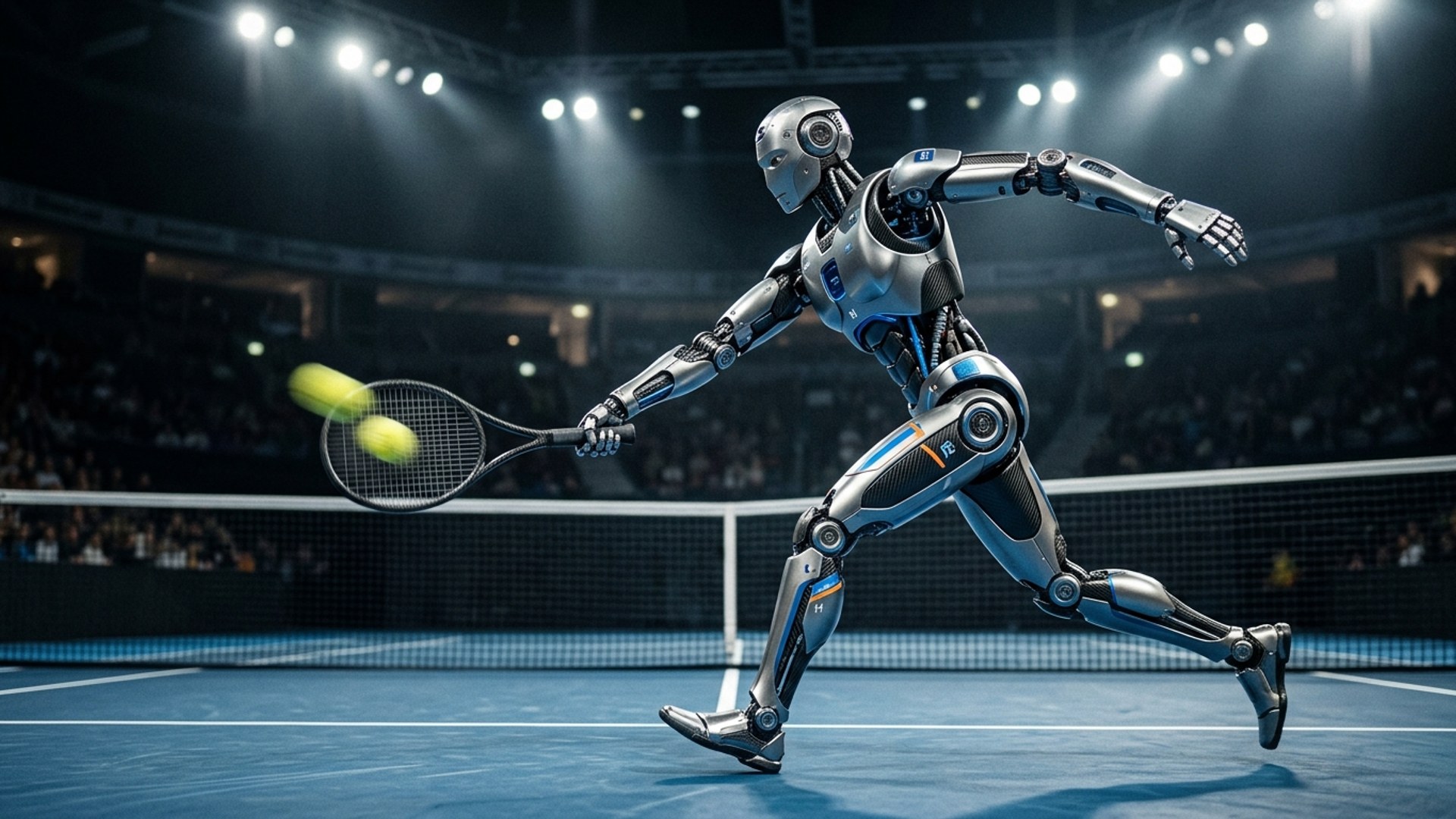
During the opening ceremony of the second World Humanoid Robot Games on August 23, 2026, humanoid robots developed by Beijing Galbot Co., Ltd. played a live, globally broadcast tennis match against human athletes. The robots achieved a milestone of more than 100 consecutive rallies, which the company claims is a new world record for humanoid robot tennis, branded as AstraTennis. Operating entirely autonomously without teleoperation or pre-programmed routines, the machines tracked high-speed balls, positioned themselves on the court, and executed a full suite of tennis maneuvers including serves, forehands, backhands, net play, and recovery shots.
The demonstration also featured a doubles format where the robots partnered with human tennis champions, requiring the machines to dynamically share court space and adapt to their partners' movements. Crucially, Galbot reported that the robots successfully regained their footing unassisted after losing balance during fast-paced exchanges. This ability to recover from stumbles in real time represents a significant hurdle overcome in dynamic bipedal or wheeled-humanoid locomotion, moving far beyond the scripted walking or dancing routines common in typical industry demonstrations.
For robotics practitioners, this demonstration serves as a rigorous test of embodied intelligence in a continuous, physical, and partially observed environment. While Galbot's commercial focus centers on its G1 model—a wheeled, dual-arm humanoid designed for structured workplaces like retail, manufacturing, and pharmacies—the underlying technology tested on the court directly translates to these sectors. The rapid sensor fusion, real-time path planning, and whole-body coordination required to hit a tennis ball are the exact same capabilities needed to navigate cluttered warehouse floors or handle delicate items in a pharmacy.
While the 100-rally benchmark indicates highly reliable ball tracking and swing timing, practitioners will need to see how these capabilities generalize to unstructured environments. A tennis court provides high contrast and predictable rules, whereas commercial spaces present occlusions, fragile objects, and poorly defined tasks. Independent verification of the AstraTennis record by the games' organizers will be the next critical step in validating these real-time decision-making claims.
This is our own summary of reporting by Unite.AI


