MLCommons Promotes AILuminate to Standardize AI Risk
MLCommons is advocating for its independent AILuminate benchmarking framework to help businesses quantify and manage AI deployment risks amid rising data breach costs and strict regulations.
MLCommons is pushing for the adoption of AILuminate, an independent, consensus-governed benchmarking family launched in December 2024 to evaluate how reliably AI systems avoid harmful outputs. The organization released AILuminate v1.1 and Jailbreak Benchmark v1.0 in June 2026 to address a critical gap in the industry: vendors grading their own products. For example, in one code review test, a vendor claimed an 82 percent bug-catch rate, which dropped to 45 percent when a rival ran it, while an independent lab found no vendor surpassed 63 percent.
The need for objective measurement is underscored by soaring liabilities. According to IBM's 2025 Cost of a Data Breach study, the global average breach cost reached $4.44 million, peaking at a record $10.22 million in the United States. Organizations utilizing unauthorized shadow AI faced an additional $670,000 in average breach costs, while 63 percent of breached firms lacked an active AI governance policy. Furthermore, the EU AI Act threatens non-compliant companies with fines up to 35 million euros or 7 percent of global turnover.
For enterprise practitioners, AILuminate shifts risk management from subjective assessments to auditable data. Instead of relying on static foundation model scores, buyers can test their specific, active configurations. This approach is exemplified by the Agent Reliability Profile, a project from the MLCommons financial services working group that was a finalist at the CDIR hackathon. This profile records bounded, falsifiable claims regarding an agent's performance within a specific operational design domain and control envelope.
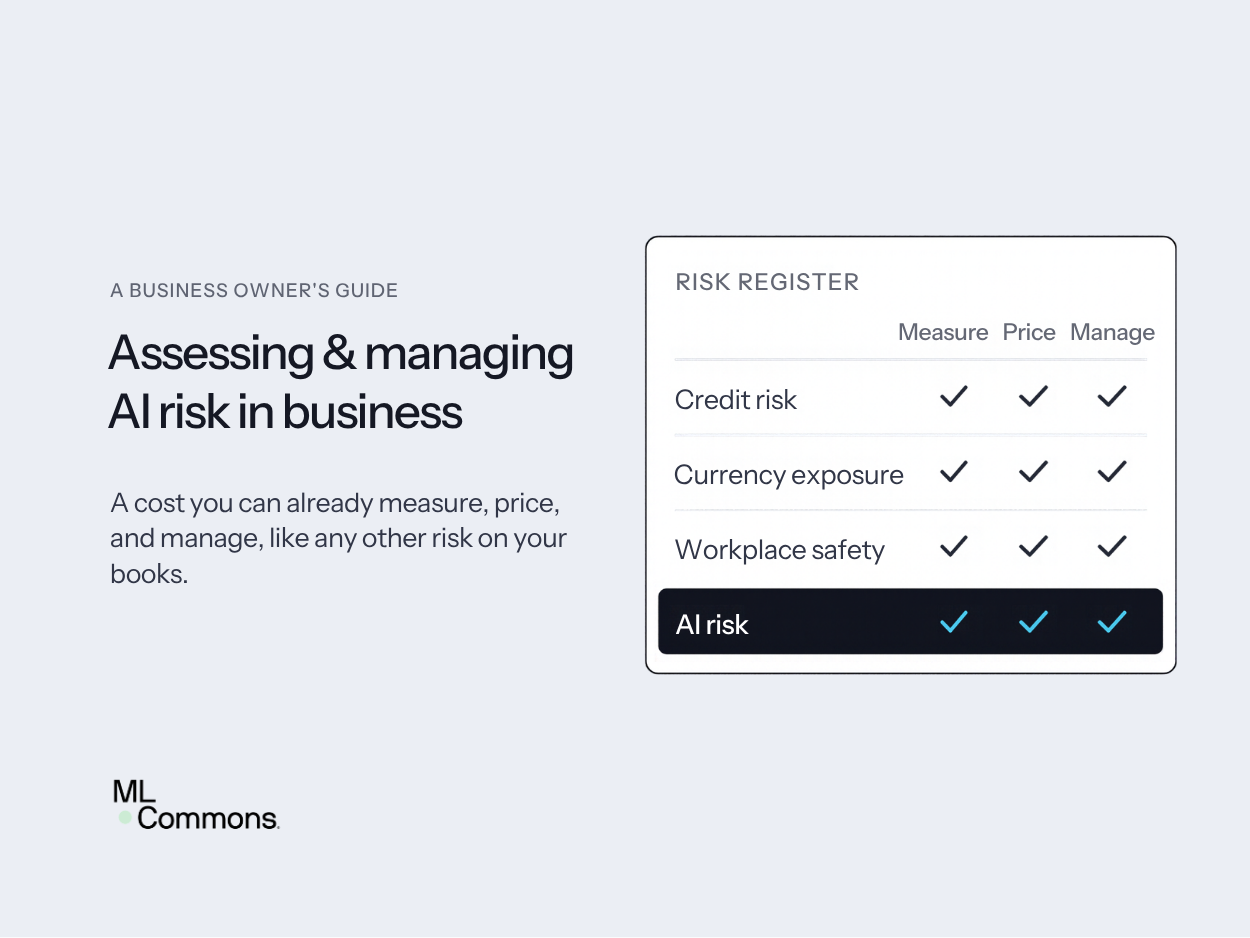
Establishing these concrete metrics is becoming essential for business survival. In late 2025, major insurers petitioned U.S. regulators to exclude AI-related liabilities from corporate policies because they could not reliably measure the underlying risks. By implementing independent benchmarks, businesses can generate the structured risk registers necessary to secure insurance coverage, satisfy auditors, and safely scale their AI deployments.
This is our own summary of reporting by ML Commons